

A Fall Alert Isn’t Prevention
Most fall prevention technology tells you when something happened.
The problem is that by then, something has already gone wrong.
So the real question in care is not: Did we detect the fall?
It is: What did we miss before it happened?
What Happens Before a Fall
In real care environments, falls rarely happen without warning.
What comes first is often subtle:
- a stumble that is recovered
- a lunge to catch balance
- hesitation before standing
- difficulty using a walking aid
- slower walking pace
- repeated movement at night
These are not incidents.
They are early warning signs.
If they are not captured, they cannot be acted on.
Detection Is Not Prevention
A system that alerts when someone is already on the floor is responding.
That has value.
But it is not prevention.
Prevention means:
- identifying deterioration earlier
- recognising patterns over time
- enabling intervention before harm
This is the difference between:
knowing what happened
and
understanding what has been changing
Why Many Systems Struggle in Real Care
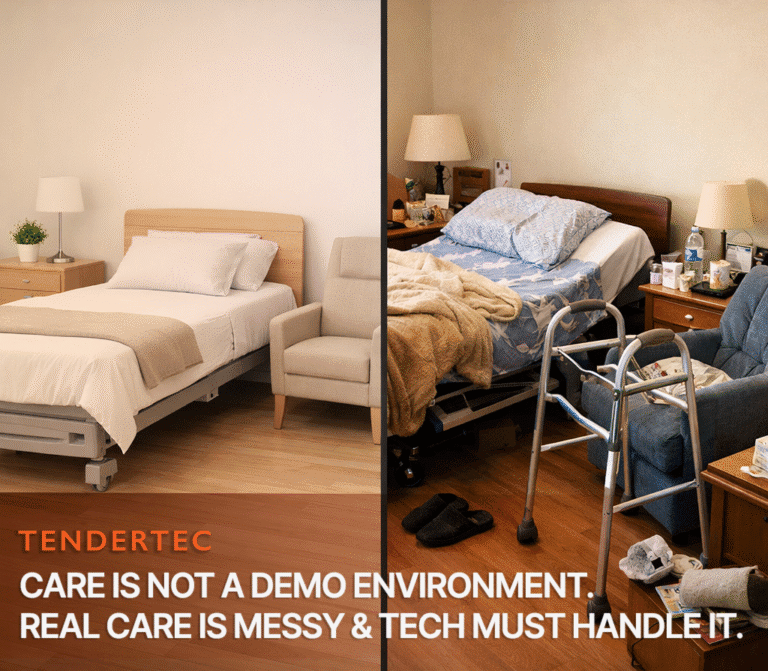
Many technologies perform well in controlled environments.
Real care is different.
- furniture moves
- routines change
- carers come and go
- behaviour varies daily
- rooms are shared
- layouts are not fixed
If a system depends on:
- fixed layouts
- recalibration
- controlled environments
it will struggle where care actually happens.
This leads to:
- missed signals
- unreliable alerts
- reduced trust from staff
And when trust goes, usage follows.
Context Changes Everything
An alert tells you that something happened.
It does not tell you:
- why it happened
- whether it was building
- whether it has happened before
Without context, care teams are left reconstructing events.
Context allows teams to:
- understand patterns
- act earlier
- plan better
- reduce repeat incidents
Built for Care vs Adapted to Care
There is a growing distinction in the market.
Some solutions are adapted from other industries.
Others are designed specifically for care.
That difference shows up in:
- usability
- reliability
- acceptance
- long-term value
Care requires technology that works in:
- complex environments
- sensitive settings
- real workflows
Not just ideal conditions.
Where Hestia Fits
Hestia® was built specifically for care.
Not as a fall detector.
But as infrastructure that helps surface what happens before incidents.
It enables:
- detection of near-falls and instability
- tracking of movement and transitions
- identification of mobility changes over time
- operation in complex and multi-occupancy environments
- privacy-first monitoring (no cameras, no audio, no wearables)
- seamless integration into care workflows
It adapts automatically to real environments, without recalibration or disruption.
The Value Over Time
The more Hestia® is used:
- the clearer patterns become
- the earlier risks are identified
- the more effective interventions are
This allows services to move from: reacting to incidents
to: preventing escalation
Final Thought
Most systems answer: What happened?
Hestia answers: What has been changing, and what should we do about it?
That is the difference between detection and prevention.
Call to Action
If you are looking for a solution that:
- surfaces early instability signals
- provides context, not just alerts
- works in real care environments
- supports prevention, not just response
Get in touch to explore how Hestia fits within your service.